01Case study · Healthcare campus
Replacing Steam Humidifiers Across a New York City Hospital Campus
As part of a campus-wide energy program at a large academic medical and research campus in New York City, GoFog replaced the existing steam humidifiers with GoFog atomizing humidifiers in six buildings. GoFog retrofitted 23 existing air handling units treating 800,000 CFM of air, with more than 20,000 lbs/hr of humidification supplied by six duplex GoFog pump systems that operate as alternating duty/standby.
 GoFog, Inc.

- Hospital campus buildings
- 6buildings
- Existing AHUs retrofitted with GoFog
- 23AHUs
- Total air treated by GoFog
- 800,000CFM
- Humidification capacity
- 20,000+lbs/hr
- Duplex GoFog pump systems
- 6duplex
- Steam humidifiers replaced
- Steam→ fog
01The project
What was the project?
The campus is a large academic medical and research campus in New York City that relied heavily on legacy steam for heating and other thermal loads. World Energy Innovations (WEI) developed and implemented a multi-phase program to move the campus from steam toward hot-water heating, combined heat and power (CHP), heat recovery and, in a later phase, electrification.
Humidification was part of that program. In conjunction with the other energy-saving initiatives, the campus replaced its steam humidifiers with GoFog atomizing humidifiers across six buildings: 23 existing air handling units, 800,000 CFM of air and more than 20,000 lbs/hr of humidification.
WEI reports that by 2025 the overall program had generated more than $33 million in cumulative utility savings, about $10 million in 2025 alone, and cut campus greenhouse-gas emissions 19% below the 2020 baseline. Those results are for the whole campus program, of which the humidifier replacement is one part.
02Why replace steam
Why replace steam humidifiers on a hospital campus?
A steam humidifier needs steam. On a campus that is moving its heating from steam to hot water, every steam humidifier left in place is a load that keeps the steam system running. Replacing them with atomizing humidifiers takes humidification off steam entirely.
An atomizing humidifier also uses far less energy. Instead of boiling water, a GoFog system uses a small pump to deliver purified water at 1,000 psi to nozzles inside the air handler, and the heat already in the airstream evaporates the fog. In GoFog's published energy comparison for 1,000 lbs/hr over 3,500 hours, a GoFog system costs an estimated $700 a year in energy, against $68,950 for a steam-to-steam humidifier and $128,800 for electric-to-steam.
For hospitals, the option has been open since ASHRAE approved atomizing humidifiers for health care facilities under Addendum m to ASHRAE Standard 170-2013.
03The GoFog system
What did GoFog deliver?
The scope of the GoFog humidification retrofit across the hospital campus.
| Item | Delivered |
|---|---|
| Project size | 6 buildings on a hospital campus |
| Air handling units | 23 existing AHUs retrofitted with GoFog, replacing steam humidifiers |
| Airflow | 800,000 CFM total air treated by GoFog |
| Humidification capacity | Over 20,000 lbs/hr |
| Pump systems | 6 duplex GoFog pump systems: alternating duty/standby pump skids |
| Program | Part of a campus-wide steam-to-hot-water, CHP and heat-recovery program |
04How it works
How does a GoFog atomizing humidifier work inside an AHU?
Each retrofitted air handler uses the same four stages as every GoFog Humidification System: purify, pressurize, atomize and evaporate.
- Purify. GoFog systems run on reverse osmosis water with no chemical additives, so the fog evaporates without leaving mineral dust in the air handler or the supply air.
- Pressurize. A GoFog pump unit raises the purified water to 1,000 psi. On this campus, six duplex pump systems supply the 23 air handlers.
- Atomize. Stainless steel nozzle manifolds installed inside each AHU break the water into fog droplets less than 20 microns in size, with staging valves matching the output to the humidity demand.
- Evaporate. The droplets evaporate using heat already in the airstream, adding humidity to the supply air with no boiler, no steam generator and no compressed air. Mist eliminators downstream catch any droplets that have not evaporated.
Because the evaporation process also absorbs sensible heat from the air, an atomizing humidifier produces an evaporative cooling effect in the airstream. This cooling is initially offset by increasing the amount of return air and, if necessary, by utilizing the hot water preheat coil. The supply air temperature sensor located at the discharge of the AHU monitors the resulting temperature and allows the control system to automatically adjust these components as the humidifier stages to meet the demand, maintaining the desired supply air temperature.
05Redundancy
Why duplex pump systems for a hospital?
A hospital cannot take its humidification offline for a pump repair. All six GoFog pump systems on the campus are duplex: two pumps on one skid operating as alternating duty/standby.
The pumps take turns as the duty pump, which spreads the run hours across both. If a fault occurs, the system automatically switches over to the standby pump and VFD, so the air handlers keep receiving 1,000 psi water while the faulted pump is serviced. This is the same high-availability design GoFog uses for hospitals, laboratories and data centers.
06The retrofit
Can atomizing humidifiers be retrofitted into existing air handlers?
Yes. All 23 air handlers on this campus were existing units. GoFog nozzle manifolds install inside the humidification section of an existing AHU, so the campus replaced its steam humidifiers without replacing its air handlers.
Spread across 23 units, the 800,000 CFM works out to an average of about 35,000 CFM per air handler. Each AHU's manifolds are sized to its own airflow and humidity load, and the six pump systems supply more than 20,000 lbs/hr between them.
Planning a hospital, laboratory or campus humidifier retrofit? Contact GoFog or call (803) 220-0101 for a custom design, energy analysis and free quote.
07FAQ
NYC hospital campus humidifier retrofit FAQ
How large was the GoFog retrofit on the hospital campus?
GoFog retrofitted 23 existing air handling units in six buildings, treating 800,000 CFM of air in total with more than 20,000 lbs/hr of humidification.
What did the GoFog humidifiers replace?
Steam humidifiers. The replacement was part of a campus-wide energy program moving the campus from steam toward hot-water heating, combined heat and power and heat recovery.
What pump systems supply the humidifiers?
Six duplex GoFog pump systems. Each has two pumps on one skid operating as alternating duty/standby and automatically switches to the standby pump and VFD if a fault occurs.
Are atomizing humidifiers allowed in hospitals?
Yes. Addendum m to ASHRAE Standard 170-2013 approved atomizing humidifiers for health care facilities, opening an energy-efficient alternative to steam humidification.
Did the air handlers have to be replaced?
No. All 23 AHUs were existing units. GoFog nozzle manifolds install inside the humidification section of an existing air handler, replacing the steam humidifier without replacing the AHU.
08Explore the system
The applications and products behind this project
Hospital humidification runs through the building's air handlers, supplied by redundant GoFog pump units.

Healthcare and Laboratories
Humidity control for hospitals and labs, using reverse osmosis water and no chemical additives.
Explore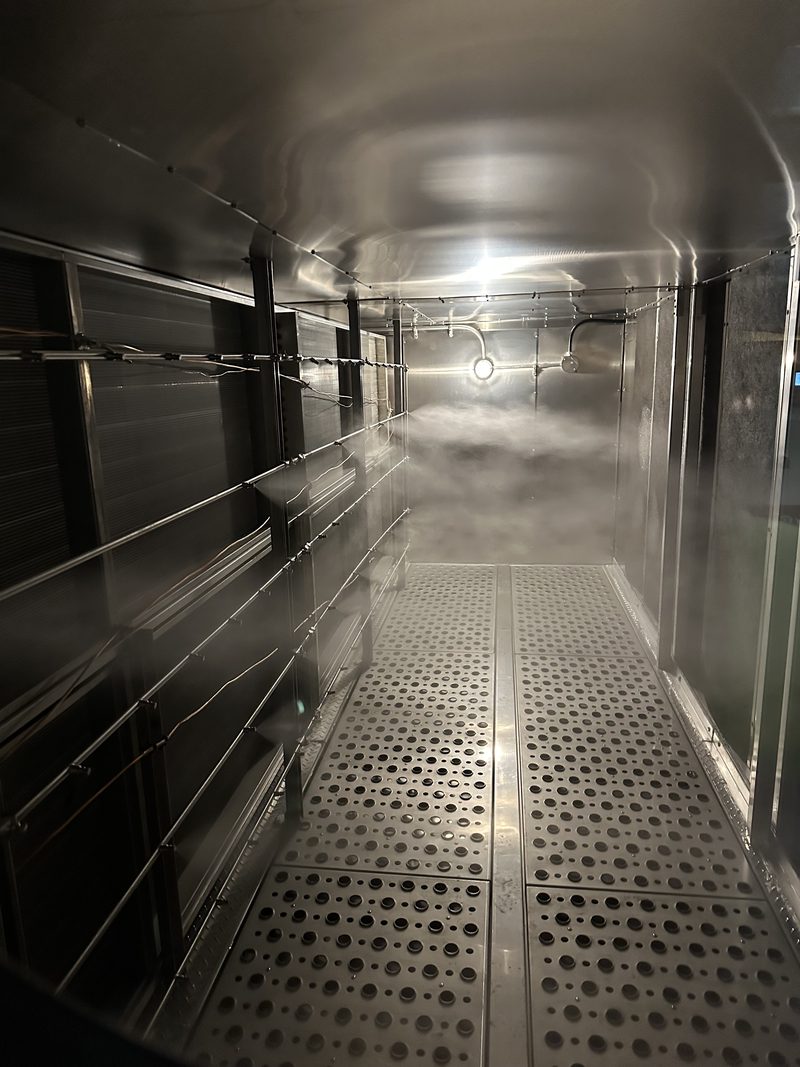
Commercial Humidification
In-duct humidification through the building's AHUs at a fraction of the energy of steam.
Explore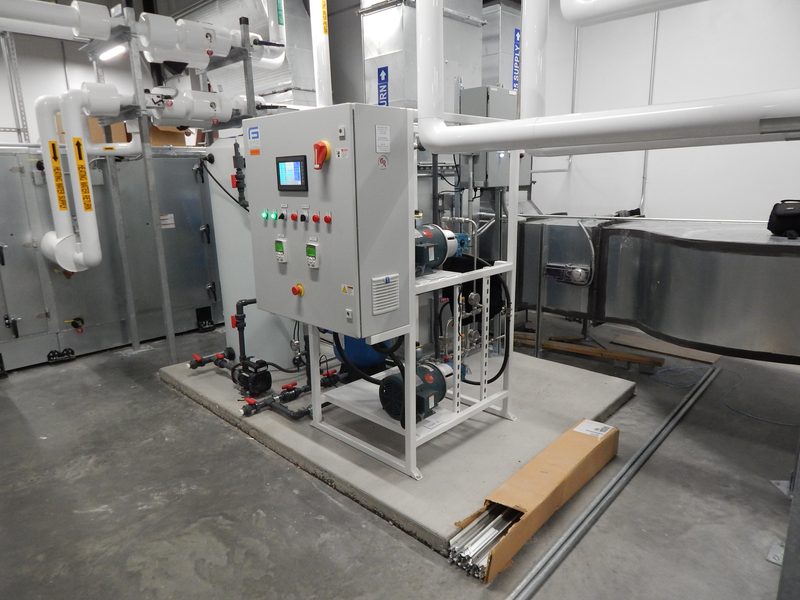
Reliable Pump Units
1,000 psi VFD-controlled pump units with duplex duty/standby redundancy.
View pump units


Take your humidification off steam.
Tell us about your hospital, laboratory or campus, and GoFog engineers will design a retrofit for your existing air handlers and provide a free quote.
